Cloudflare has shipped two models that make choices instead of writing prose. Clef and its smaller sibling Clef-flash are "decision models" for AI agents. Cloudflare's main argument for them is speed, measured against the current reference point in this small category, TypeSafe AI's Jev.
The company also makes a bolder claim. In its words, "a human does not necessarily need to be in the loop for agentic decisions anymore."
What a decision model does
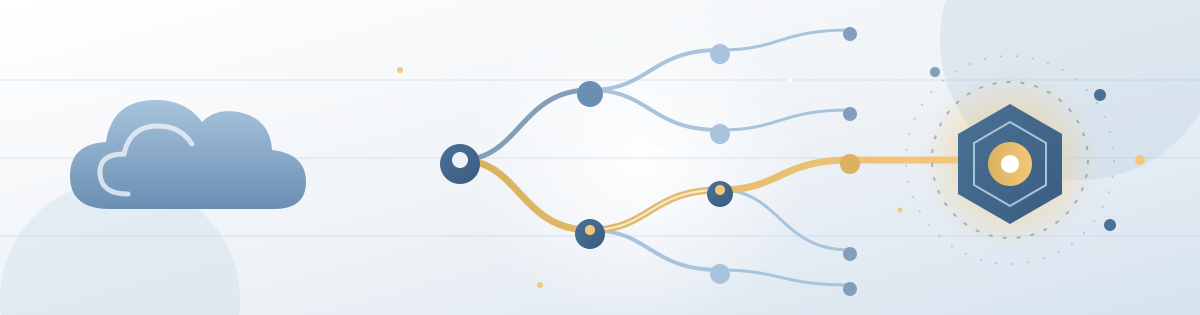
A decision model does not answer with a paragraph. It takes an input, picks from a fixed set of options and attaches a probability to each one. Cloudflare's example is a customer support message. Clef rates how urgent the message is and which team should handle it. Code further down the pipeline then acts on that output. It can route the ticket, escalate it, or pass it to a person.
Apple is adding new restrictions to "Full Disk Access," one of the most powerful permissions an app can hold on macOS. The company says desktop AI agents have changed the risk picture. A setting that was once mostly about backups now opens a much bigger door.
The announcement came in a blog post aimed at developers. It follows a week of uncomfortable reporting about what AI apps on the Mac can see.
What Full Disk Access actually unlocks
Full Disk Access was built for a practical reason: backup software needs to reach everything on a machine to do its job. According to Apple, an app with this permission can read files, mail, messages and even browsing history.
Legato, a hearing technology startup, has started selling its first product. Legato Frames are glasses with hearing assistance built into the arms, and they use AI to pick voices out of background noise. The company announced on Thursday that they are now available. Prices start at $999. The glasses are aimed at adults with hearing loss up to a moderate level.
The company says it wants to make hearing care easier to access by addressing three common reasons people avoid hearing aids: cost, comfort, and stigma. Placing the technology in a pair of glasses is its answer to all three.
US companies are running more AI workloads than ever, and they are paying less for them. That is the main finding of the latest Ramp AI Index, compiled by Ramp economist Ara Kharazian.
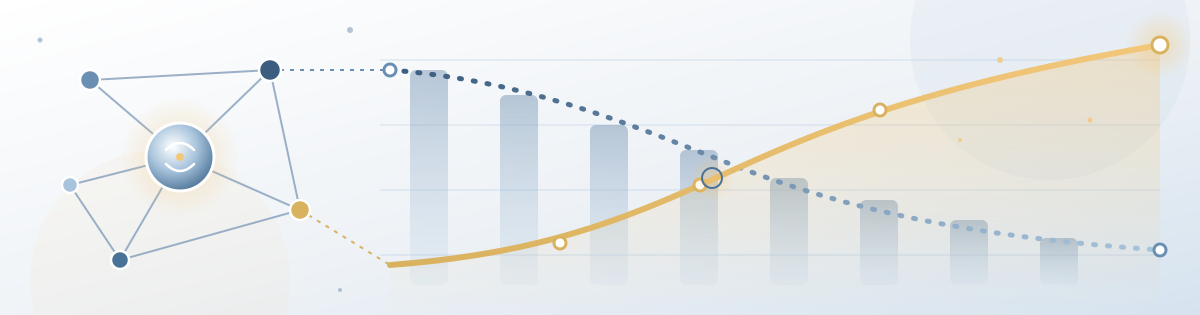
The two lines are moving in opposite directions. Spending peaked in July and has fallen since. Usage has climbed about 50 percent over the same period and reached a record high at the end of September.
Why the bill is shrinking
Kharazian identifies two causes:
Price cuts on top models. The most capable models have become cheaper to call.
Better budget options. Standard and lite models have become cheaper and more efficient, so more work can move to lower-cost tiers.
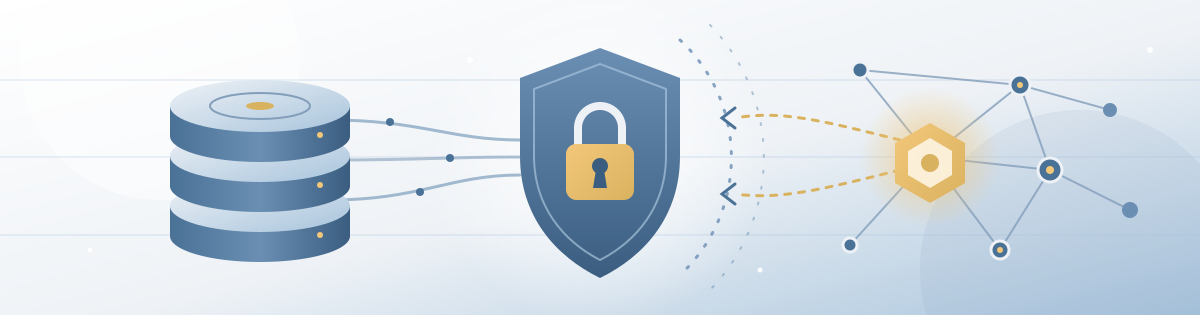
IBM has released a self-hosted version of IBM Bob, its agentic software development platform. Companies can now run AI-assisted development and application modernization on their own infrastructure instead of sending code to an outside service. The option covers on-premises data centers, private clouds, sovereign clouds and fully air-gapped environments. A sovereign cloud keeps data under a specific country's or region's jurisdiction. An air-gapped environment is cut off from external networks entirely.
The target customer is clear. These are organizations whose source code is sensitive, whose data is regulated, or whose systems are too critical to expose to an externally hosted AI tool. IBM is pitching the release to financial services, government, healthcare and critical infrastructure, and to any business worried about protecting its intellectual property.
CyrioX is financed by advertising. You can choose how you want to use this website:
With advertising: we load an advertising script from a third-party ad network. The ad network may set cookies, use your IP address and device information, and may process data outside the EU. We also count your visits for our own visitor statistics (with a random ID stored in your browser).
Ad-free for €0.99 per month: no advertising and no advertising tracking. Cancel at any time.
You can change your decision at any time via "Cookie Settings" at the bottom of every page.