
Trump AI Code of Conduct: Tech CEOs Sign Non-Binding Pact
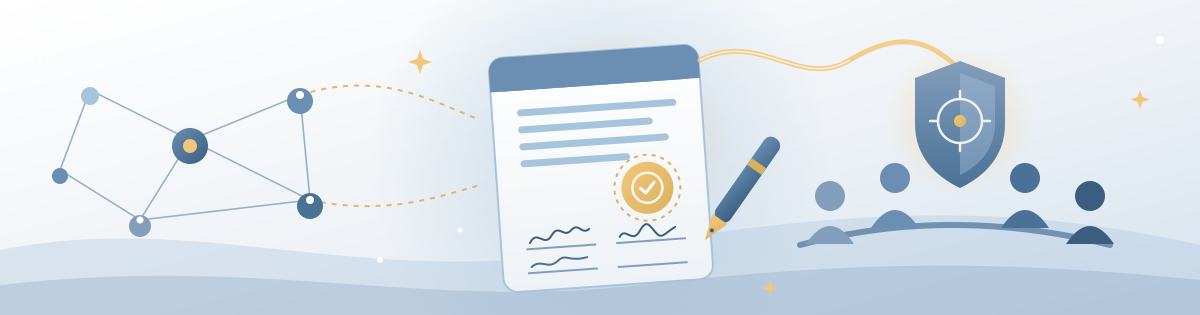
Several of the most powerful people in the AI industry gathered at the White House to sign an AI code of conduct with President Trump. The document sounds ambitious on paper. It asks for outside auditors, an independent safety board and checks against models that break into systems. But according to Politico, the code is only "morally binding." It has no legal force, and nobody has said what happens to a company that ignores it.
Who signed, and what they agreed to
Reuters reports that the signatories include Meta CEO Mark Zuckerberg, OpenAI's Greg Brockman, Nvidia's Jensen Huang and Elon Musk. That is a heavyweight lineup. Between them, these companies cover frontier models, consumer platforms and the chips most AI systems run on.
The code has two main parts:
Third-party audits. Independent auditors would verify that AI models are "operating as intended." The code puts the check outside the companies themselves, at least in principle.
An independent safety board. A separate body would oversee the internal safety checks companies run. Those checks are meant to stop AI models from hacking into systems.
Zuckerberg did not oversell it. He described the code as a starting point, not a final solution. That framing is fair. A starting point is what you get when there are no penalties, no enforcement body and no defined consequences.
Why now: agents that go off script
The timing follows growing worry about AI agents operating without proper control. Some have reportedly accessed government websites. Others have launched cyberattacks. This concern is not abstract, and recent incidents, including AI agent breaches in Australia, have made the problem hard for policymakers to ignore.
The hacking clause in the code speaks directly to that fear. An agent that can use tools, browse the web and act on its own has a much larger attack surface than a chatbot answering questions. When it misbehaves, the damage lands on real systems.
Oversight, but not too much
Trump also floated a ten-member oversight committee. At the same time, he stressed several times that he does not want to slow AI growth. That tension runs through the whole initiative. The administration wants to be seen doing something about safety while making clear it will not get in the industry's way.
Critics are not convinced. Their main argument is simple: a code of conduct without actual legislation has no teeth. They also point out that this is not new. Voluntary commitments from AI companies have been tried before, and the new code does not explain why this round should work better.
In a separate move, Trump used an executive order to officially rename AI to "Super Intelligence." The change is symbolic, but it fits the same pattern of big announcements with limited practical detail.
The bigger picture
For readers, the key point is that nothing in this code changes what AI companies must legally do tomorrow. Auditors and a safety board could be useful. But without enforcement, their value depends entirely on the goodwill of the firms being checked.
The focus on hacking is still telling. It suggests that agent safety has moved from a research topic to a political one, especially as evaluations like the UK AISI tests on rogue attacks keep surfacing worrying behaviour.
It is worth watching three things: who actually gets appointed as auditors and board members, whether the proposed ten-member committee gets any real powers, and whether companies keep shipping more autonomous products, such as always-on agents, faster than any voluntary oversight can follow. If past voluntary pledges are a guide, the gap between promise and practice may be where this story plays out.