
Gemini Agent: Google Cloud Bets on One Assistant Everywhere
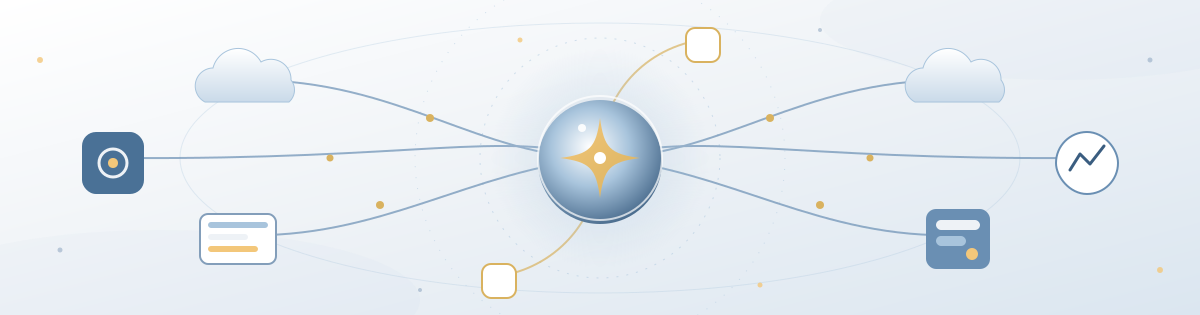
Google Cloud wants its AI to live wherever employees already work. On October 8, the company introduced Gemini agent, a single assistant that can act on its own, write code and finish tasks on web, mobile and desktop. Users don't need a new app to reach it. The agent works from the command line, inside Google Workspace, Microsoft 365 and Slack, and even within third-party applications. Google describes the goal as an "omnipresent" assistant that follows the user rather than the other way around.
Objectives instead of instructions
Google Cloud CEO Thomas Kurian said Gemini can answer questions, take on knowledge work, produce images and media, and turn rough ideas into finished products. He framed the change as a new way of delegating.
"You give it objectives, not instructions. You delegate an outcome and come back to finished work," Kurian said. "For an agent to do that, it has to be connected to your personal workflows, your systems of record, and your enterprise controls."
One memory, many coworkers
The product follows a pattern now common across the industry: persistent execution. Gemini keeps one shared set of memories, context and personalization across every channel and every sub-agent it runs.
In practice, it behaves like a teammate that remembers what it has been told. It can also spin off smaller coworker agents, each with its own identity, its own area of expertise, its own @agents.company.com email address and its own persistent storage. Those sub-agents only see the context that the user or their team chooses to share.
Model choice is part of the package. Each job runs on a model suited to the task. Routine work can go to Gemini Flash, a small and fast model, while long-horizon jobs can use a frontier model such as Argon. Anthropic's Claude models are available from launch, and Google says other private and open models will follow.
Skills, tools and company data
Kurian stressed that the agent should understand a company's full business context, from pricing and product portfolios to how individual departments operate. Gemini grounds its answers in company data and pulls institutional knowledge to the surface.
The connector list is long:
- Collaboration: Confluence, Microsoft Office, Teams, Slack and Workspace
- Developer tools: Git and Jira
- Enterprise platforms: Salesforce and ServiceNow
- Databases: BigQuery, Databricks, Postgres and Snowflake
- Local files on desktops
On top of that sit reusable skills: bundles of instructions, knowledge and workflows that teach agents to carry out specific multistep tasks. Gemini ships with a global library of them. Companies can publish their own to a shared internal registry, or simply ask an agent to turn a task it just completed into a reusable template.
The system also keeps learning. Session memory can run for days while the agent reads documents, talks to people and coordinates with other agents, and it updates its picture of how each user works and what they expect. Google says the agent spends as much effort learning what users do as it does calling tools.
The first domain-specific skills target data work. Data scientists and engineers can describe an outcome in plain language, and Gemini will generate PySpark code, provide a notebook for editing and testing, train a model and troubleshoot problems on its own. For business users, operational BigQuery reporting skills and the Knowledge Catalog let the agent build and save queries on request. Once a report is saved, teams can rerun it without extra token costs and get consistent, verified answers each time.
Putting a ceiling on spend
Cost control gets unusual prominence in the launch. Google notes that per-token prices have fallen by about 98% since 2024, but enterprise AI volume has grown sharply, so bills have not necessarily shrunk.
Its answer has several layers. Flexible spending options announced in August go live now. Multimodel orchestration splits complex jobs, sending easy parts to quick models and hard parts to frontier ones, while smart routing places each workload on the model that offers the best performance at the lowest cost.
Administrators can also set hard spending limits in the Cloud Billing Console. Gemini tracks token usage and pauses when a cap is hit. Work only resumes after someone approves it in the console and accepts that the budget will be exceeded. Because tracking happens per project, companies can charge AI costs back to individual departments and plan budgets team by team.
Our Take
Gemini agent is less a new model than a bet on placement: Google wants to be the layer that sits across every tool a company already uses, including Microsoft's. That puts it in direct competition with similar "work layer" pitches from other enterprise vendors.
Two details stand out. Sub-agents with their own email addresses and storage make agents look more like staff than software, which raises practical questions about permissions and oversight that enterprises will need to answer. And the heavy focus on spend caps suggests buyers are worried about runaway token bills, a concern also visible in Cohere's recent spending limits.
It is worth watching whether the "objectives, not instructions" promise holds up in messy real workflows, and how quickly the promised non-Google models arrive.