
Seismora Control Plane Routes AI Across Devices and Clouds
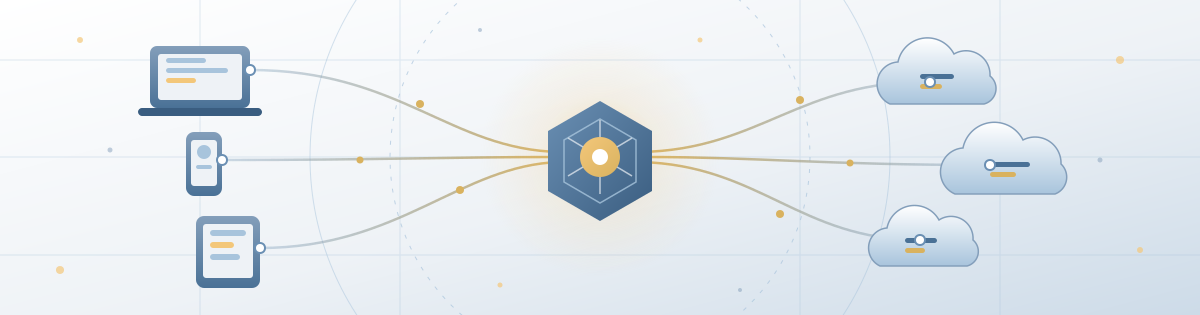
As AI applications spread across phones, edge servers and multiple cloud providers, someone has to decide where each piece of work should run. Seismora Inc. wants to make that decision automatically. The startup is building what it calls an intelligent control plane: a networking layer that coordinates AI workloads across devices, edge infrastructure and cloud providers so developers don't have to write that logic into every application themselves.
Founder and CEO Vito Palermo described the project in an interview with John Furrier for theCUBE + NYSE Wired: AI Luminaries series, produced by SiliconANGLE Media's livestreaming studio, theCUBE. Neo4j sponsored theCUBE's coverage of the series, though SiliconANGLE states that sponsors have no editorial control over its content.
From human traffic to machine traffic
Palermo's starting point is a change in who is talking to whom on the network. "The AI boom creates a scenario where we're moving from human-to-system communication to machine-to-machine," he said.
His answer is a control plane that lets AI traffic move "regardless of the network, regardless of who the neocloud is or the hyperscaler, or even the devices themselves." Neoclouds are the newer, AI-focused cloud providers that rent out GPU capacity, as opposed to hyperscalers like the large established public clouds.
The core idea is simple. Different parts of one AI application may need very different computing resources. Some tasks can run locally on a phone. Others belong at the edge, closer to the user. Heavier jobs may need specialised cloud hardware.
How the routing is supposed to work
Palermo gave a concrete example. Based on what a user is trying to do in an application, the system could decide to run some of the work on an iPhone and some at the edge. A more demanding task, such as building a digital twin with Nvidia's Omniverse, could be sent to a neocloud.
"And the control plane automatically makes those decisions and optimizes the cost, too," he said.
Seismora calls this approach "cognitive routing." The system picks where AI work runs based on four factors:
- Capability: what the hardware or model can actually do.
- Cost: what each option charges.
- Latency: how quickly results need to arrive.
- Policy constraints: rules about where work and data are allowed to go.
The on-device part of this picture lines up with a wider push to give personal AI agents more local context, with the cloud reserved for tasks that need it.
Built for developers, not end users
Seismora is not selling to consumers. According to Palermo, its intended customers are developers building agentic applications for end users. Those developers would plug into the control plane rather than design their own routing systems.
Palermo argued that heterogeneity is now a given in enterprise AI. "You want to be heterogeneous because, frankly, the enterprise today, I'm sure they have multiple neoclouds they work with, they have multiple models they work with," he said. "My problem is routing across all of these providers, and that's the focus."
He sketched a stack in which open-weight models come from providers such as Fireworks.ai, contextual knowledge comes from Neo4j's graph technology, and compute and storage are spread across the edge and the enterprise. The goal, in his words, is "to be able to move intelligence where it makes sense."
A signal from the Stripe-OpenRouter deal
To show that this market is real, Palermo pointed to Stripe Inc.'s agreement to acquire OpenRouter Inc., a platform that routes requests across AI models. The deal was announced in August, at a price reportedly around $7.5 billion. For Palermo, it is evidence of growing interest in infrastructure for machine-to-machine transactions.
OpenRouter works at the model level, sending requests to different AI models. Seismora is aiming at a broader layer that also takes in where the compute physically sits, from a user's handset to a third-party data centre.
Our Take
Seismora's pitch fits a pattern we have been tracking: as agents multiply, the interesting problems move away from the model itself and toward the plumbing around it. Routing, cost control and placement are becoming products in their own right. Recent work on fast decision models for AI agents and on controls for agent workloads on neoclouds points the same way.
The Stripe-OpenRouter price tag suggests investors see value in owning this traffic layer. Still, Seismora has so far described an approach, not shared customers, benchmarks or pricing. It is worth watching whether "cognitive routing" can enforce policy constraints reliably across providers it does not control, and whether developers will trust a third party to make those placement decisions. A control plane that sees every AI request is also an attractive single point of failure, so its security model will matter as much as its cost savings.