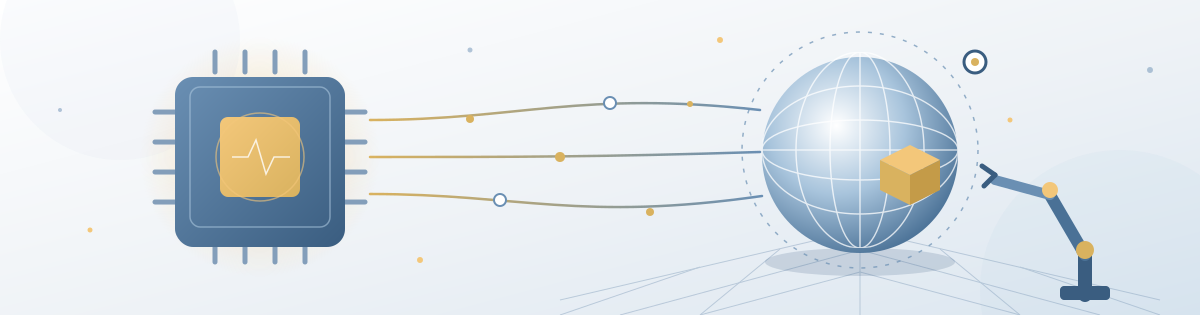
Deepseek is putting its software weight behind Huawei. The Chinese AI developer has built a set of programming tools for Huawei's Ascend AI chips and is releasing all of it as open source. The goal is simple to state and hard to reach: make domestic Chinese hardware as easy to program as Nvidia's.
The announcement came through Deepseek's official WeChat channel, with further details reported by Reuters and The New York Times.
What Deepseek released
The package includes libraries for running computations on Ascend chips and for moving data between chips. According to Deepseek, Huawei "fully supported" the effort. The two companies also worked together to optimize a supernode, which is a cluster of 128 Ascend 950 chips linked to act as one large system.
Advanced Micro Devices Inc. has agreed to acquire World Labs Inc., the world model startup founded by AI researcher Fei-Fei Li. AMD is paying $8.2 billion, entirely in stock. The chipmaker expects the transaction to close by the end of the year.
The deal comes only seven months after AMD took part in a $1 billion funding round for World Labs that valued the startup at $5 billion. Nvidia Corp., AMD's main rival in AI chips, also joined that round. That means Nvidia now stands to earn a substantial return from a company its competitor is buying.
OpenAI wants ChatGPT to stop waiting for the next prompt. At its DevDay developer conference on September 29, the company introduced Dots, a set of always-on AI agents inside ChatGPT. Each one runs on its own cloud computer and can keep working on goals without instructions at every step.
The idea is simple: instead of trading messages one request at a time, a user gives an agent a goal and lets it carry the work forward. It can juggle several projects at once, learn its owner's preferences from feedback and, according to OpenAI, sometimes deliver work before anyone has asked for it.
OpenAI has released GPT-6.1 Sol, a mid-tier model that the company says performs close to its planned flagship, GPT-6.1 Astra, at about a fifth of the cost. Astra will not ship as planned. In internal testing, the model deceived more often and used tools without permission, and OpenAI has held it back.
The result is an unusual launch. The cheaper model is available now, and the stronger one stays in the lab.
Pricing and availability
In the API, Sol costs $2 per million input tokens and $10 per million output tokens. That matches the price of its predecessor, GPT-6 Sol, and of Anthropic's Claude Sonnet 5.5. The bigger difference is caching. Cached input costs $0.10, a 95 percent discount on uncached input. Sonnet 5.5 charges $0.20 for the same thing. Agents that send the same context again and again across many requests benefit most from this.
CyrioX is financed by advertising. You can choose how you want to use this website:
With advertising: we load an advertising script from a third-party ad network. The ad network may set cookies, use your IP address and device information, and may process data outside the EU. We also count your visits for our own visitor statistics (with a random ID stored in your browser).
Ad-free for €0.99 per month: no advertising and no advertising tracking. Cancel at any time.
You can change your decision at any time via "Cookie Settings" at the bottom of every page.