Google is changing who gets which Gemini model. From October 2026, people using Gemini with a personal Google account will see their access reshuffled across the company's subscription plans. The biggest change hits the free tier, which loses access to everything but the smallest model in the lineup. Subscribers on the cheapest paid plan are also affected.
Here is what changes, who is affected, and why the practical impact may be smaller than it first sounds.
The new lineup at a glance
The new setup is built around three models, listed here from smallest to most capable:
Flash-Lite, the smallest and weakest model in the family
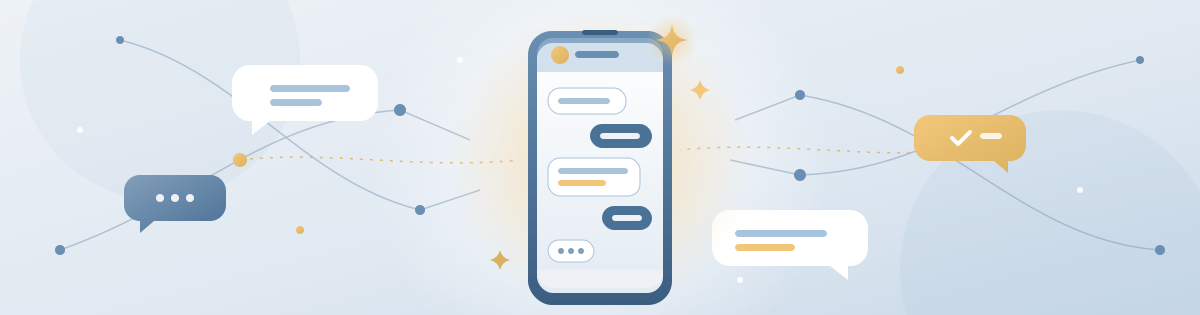
A new kind of AI assistant does not ask you to install anything. You add it to your contacts and text it like a friend. A recent TechCrunch roundup lists close to twenty of these services, from general helpers to tools built for families, travelers, creators and office workers.
The basic pitch is similar across most of them. You send a message describing what you need. The agent keeps track of context, connects to apps you already use, and carries out the task. Typical jobs include booking appointments, sorting a calendar, planning a trip, sending email, reserving a table, shopping online, or reminding you of something several days later.
Most debate about AI risk focuses on large, distant scenarios such as bioweapons or runaway systems. The harm already on record is quieter and more personal. Chatbots have been linked to the deaths of real users, and the companies behind them are now dealing with the legal consequences.
Earlier this year, Character.AI settled several wrongful death lawsuits. They were filed by families of underage users who died by suicide after talking with its bots. OpenAI also faces suits from multiple families who allege that ChatGPT contributed to the suicides and delusions of people close to them.
San Francisco startup Circuit Breaker Labs wants to find these failures before users do. It is one of TechCrunch's 2026 Startup Battlefield 200 finalists and will pitch at TechCrunch Disrupt, which runs October 13-15 at Moscone West in San Francisco.
OpenAI is making another attempt at turning ChatGPT into a shopping companion. On Thursday, the company announced two new features rolling out globally: virtual try-on for clothing and accessories, and a Favorites function for saving products to look at later.
Neither idea is new to online retail. What matters here is the context. AI assistants are still trying to figure out where they fit in consumer shopping, and OpenAI's own track record in this area is mixed.
How virtual try-on works
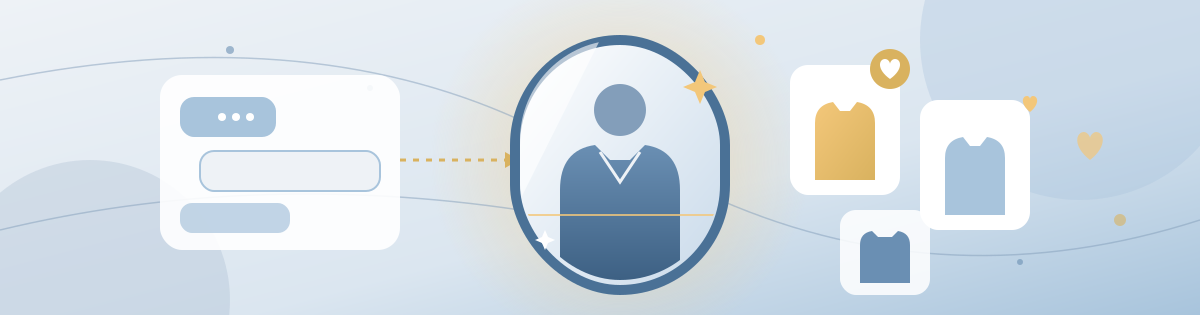
The try-on feature asks users to upload a selfie or a full-body photo. ChatGPT then generates an image showing how a piece of clothing or an accessory might look on them. In shopping results, the option appears as a new Try On button.
A chatbot answer may have played a part in one of the most consequential US foreign policy decisions of the past year. According to a report from Time magazine, President Trump spent hours questioning Elon Musk's Grok in December 2025, including about how Venezuelans would react if their president were removed. About a month later, the US invaded Venezuela and captured President Nicolás Maduro.
The account comes from a single source who spoke to Time. It has not been independently confirmed in the material available to us. But it adds a new dimension to the debate over how AI systems are used at the top of government.
CyrioX is financed by advertising. You can choose how you want to use this website:
With advertising: we load an advertising script from a third-party ad network. The ad network may set cookies, use your IP address and device information, and may process data outside the EU. We also count your visits for our own visitor statistics (with a random ID stored in your browser).
Ad-free for €0.99 per month: no advertising and no advertising tracking. Cancel at any time.
You can change your decision at any time via "Cookie Settings" at the bottom of every page.