
Google Suncatcher: Testing AI Data Centers in Orbit
The push to build more AI capacity has mostly been a story about land, power lines and cooling on the ground. Google is now testing a different route: taking part of that infrastructure off the planet altogether.
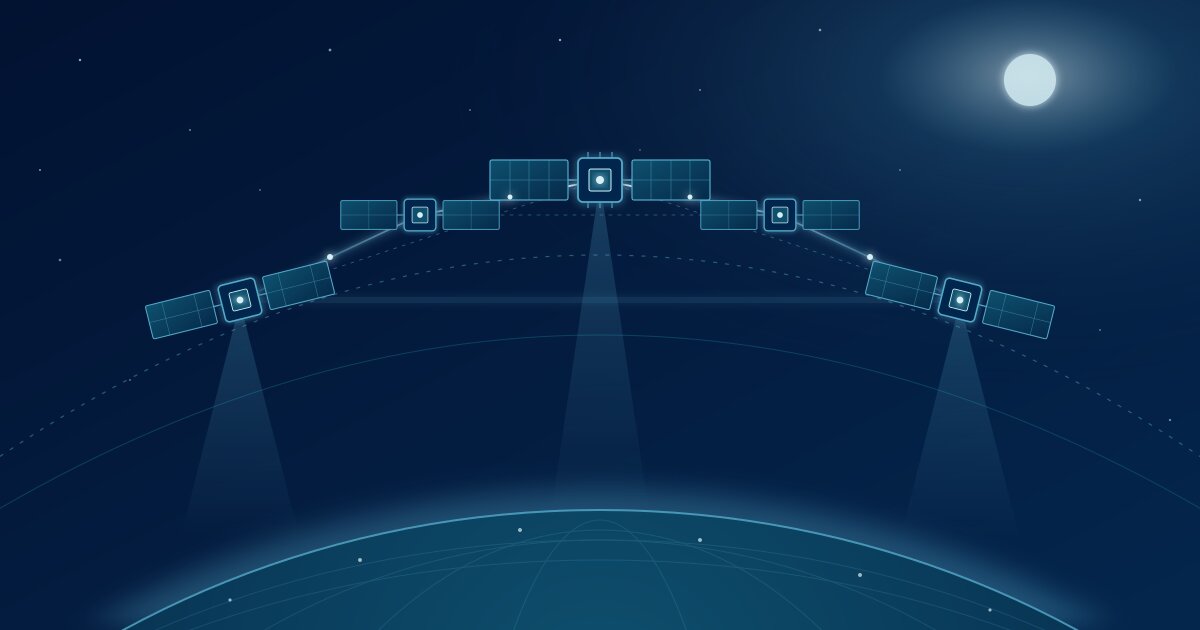
The company's project is called "Suncatcher". The idea is to run AI computing in orbit and power it with solar energy rather than a terrestrial grid. It is an early-stage effort, and the first hardware is about to leave the ground.
A fridge-sized first step
According to The New York Times, Google's first experimental satellite, named "MVP", is scheduled to launch on 1 October. It will fly on a SpaceX Falcon 9 rocket from Vandenberg Space Force Base in California.
The satellite is roughly the size of a refrigerator. It was built and tested at the San Francisco lab of Planet Labs. Its ambitions are modest. James Manyika, a vice president at Google, says it should have enough computing power to answer simple AI queries from space.
That is a long way from a working data centre. But the purpose of a first launch like this is not scale. It is to show that the basic chain works: solar power in orbit, chips running in space, and responses coming back down to users.
Google is not alone
Google is not the only company looking up. SpaceX and Blue Origin are also working on orbital data centres. The appeal is easy to see from the ground. Every new AI campus needs power and cooling, and it needs to be built somewhere. Projects on Earth can also stall for reasons that have nothing to do with the chips, as the recent force majeure notice on the Stargate campus shows.
In orbit, the sun offers a power source that does not depend on local grids. That is the core promise behind Suncatcher's name.
The numbers behind the problem
The engineering challenge becomes clear when the figures are set side by side. Travis Beals, a manager at Google, estimates that around 10,000 satellites would be needed to replace a single 1-gigawatt data centre on Earth.
For comparison, MVP is one satellite designed to handle simple requests. Getting from there to the output of a large ground-based facility means building, launching and operating a fleet thousands of times bigger.
Three obstacles stand out:
- Cooling. In the vacuum of space, there is no air to carry heat away from hardware. The cooling methods that data centres rely on do not carry over directly.
- Radiation. Cosmic radiation can damage chips. Hardware in orbit has to cope with conditions that servers on the ground never face.
- Launch costs. Getting mass into orbit is still expensive. For the concept to make economic sense, transport costs would need to fall to around $200 per kilogram.
Each of these problems would be hard on its own. Together, they explain why the first satellite is testing whether the approach works at all rather than trying to match the performance of ground-based hardware.
A long timeline
Even the more optimistic voices are not promising quick results. Jeff Bezos expects it could take up to 20 years before orbital data centres become cheaper than facilities on Earth.
That timeline matters. It frames Suncatcher and similar projects as long-term bets, not an answer to the capacity crunch AI companies face today. Ground-based data centres will carry the load for the foreseeable future, and the constraints on how fast chatbots respond, from compute to memory bandwidth, will continue to be solved mainly on Earth.
Why the test still matters
A single satellite answering simple AI queries will not change the economics of computing. What it can do is replace speculation with data. Engineers will learn how chips behave under radiation, how heat can be managed without air, and how well solar power supports real workloads in orbit.
Those lessons will shape whether the 10,000-satellite figure is a hard limit or a starting point for further work. They will also show whether the $200-per-kilogram threshold is the only barrier, or one of several.
For now, the question is not whether orbital data centres can replace ground-based ones. It is whether the basic building blocks work well enough to justify the next step. The 1 October launch is the first chance for Google to find out.
Sponsored Recommended for you – discover more →