
Tavus Griffin: AI Avatar Fooled 48% on One-Minute Calls
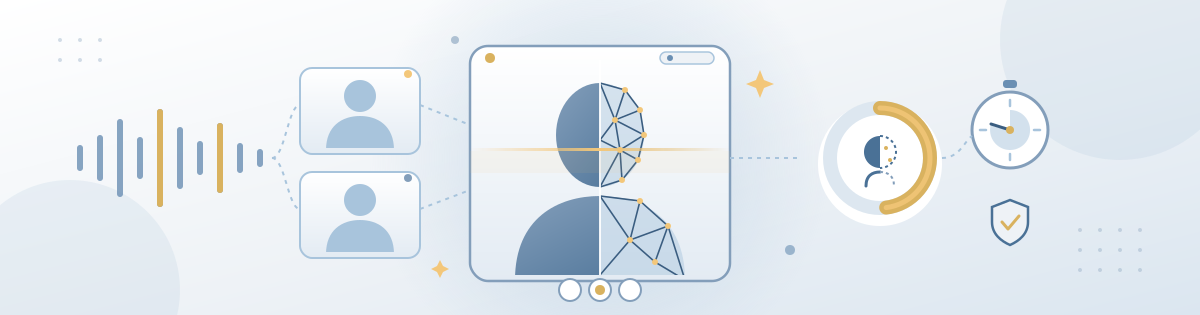
Tavus, a San Francisco startup, wants its AI to hold a face-to-face conversation well enough that you can't tell it is a machine. Its new model, Griffin, is the closest the company has come so far. In Tavus' own study, nearly half of participants finished a one-minute video call convinced they had been talking to a human.
What Griffin is
Tavus calls Griffin the first "Human Interaction Model," or HIM. The label describes a class of model built to understand and carry on face-to-face conversations in real time. It is meant to do more than generate text or a talking head.
Griffin takes in more than words. It processes speech, facial expressions, tone of voice, gestures and pauses. It does this while receiving video from the other person and generating its own video in response. That two-way loop is the core idea. The model is supposed to read the person on the other side of the camera and react to them, not just recite an answer.
The numbers
Tavus reports two sets of results.
-
The one-minute call test. In a Tavus study, 48 percent of participants believed Griffin was a real person after a one-minute video call. According to the company, previous systems topped out at two percent.
-
The Nvidia evaluation. Tavus describes this as an independent Nvidia test that measures how human an AI feels in direct audio-video conversation. Griffin scored 3.83 points. Real humans scored 3.92. The previous best AI model reached 2.80.
Both results point the same way. On the Nvidia measure, Griffin sits 0.09 points behind actual people and more than a full point ahead of the prior best model. On the call study, the jump from two percent to 48 percent is the kind of shift that changes what a product can do, not just where it lands on a chart.
Some caveats apply. The 48 percent figure comes from Tavus' own study. The Nvidia test is called independent by Tavus. And the call lasted one minute. Short conversations hide a lot. Whether the illusion holds over ten or thirty minutes is a separate question, and the available material does not answer it. Tavus has published more detail in its research report.
Limited access, for now
Griffin is not broadly available. A preview version, Griffin-Lite, is open to "select testers as a research preview." Tavus says a more capable version will follow once "safety concerns are addressed."
That wording stands out. The company is openly linking the release of its stronger model to unresolved safety issues. This suggests it sees real risk in a system that people mistake for a human about half the time.
The use cases Tavus lists are practical:
- Tutoring
- Practicing difficult conversations
- Camera-based tech support
Each of these benefits from a partner that can see you, hear your tone and notice when you hesitate. A tutor that picks up on confusion in a student's face, or a support agent that can look at whatever the user points the camera at, needs exactly the kind of multimodal reading Griffin is designed for. Rehearsing a hard conversation also works better when the other side reacts to your expression, not just your words.
Who is behind it
Tavus was founded in 2020 and has raised about $64 million. It started out building personalized AI videos for sales and marketing. It then expanded into live video conversations with digital personas. Griffin is the next step on that path: from pre-rendered clips, to live avatars, to a model meant to interact like a person.
The Bigger Picture
This suggests real-time conversational AI is moving beyond voice into the full face-to-face channel. Voice has been the main battleground so far, with products such as streaming transcription for voice agents and strong investor interest in voice AI companies like ElevenLabs. Griffin pushes the same idea into video, where expression, gesture and timing all carry meaning.
For readers, the upside is fairly clear: more natural tutoring, coaching and support. The downside is the 48 percent figure itself. A system that half of people take for human after one minute raises obvious questions about disclosure and possible misuse. These questions arrive at a time when regulators are already looking more closely at AI developers, as the FTC probe into AI labs shows.
Three things are worth watching. First, which "safety concerns" Tavus names before the full release, and how it says it has addressed them. Second, whether it commits to telling users clearly that they are talking to an AI. Third, whether outside researchers can reproduce the results, especially over calls longer than a minute.