
Biohub Leads $1.8B Push for AI Models of Cell Behavior
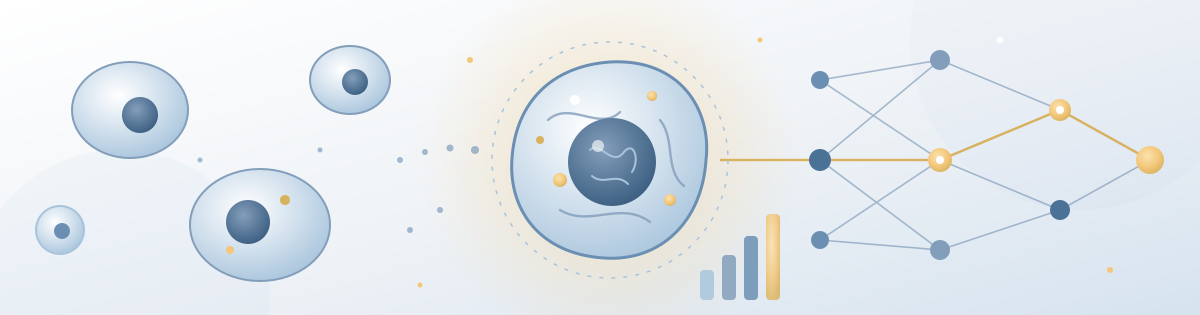
Can an AI model learn how a living cell will behave before anyone runs the experiment? A group of nonprofits, tech companies and US government agencies now plans to spend $1.8 billion finding out. The goal is a set of models that predict cell behavior, which could speed up drug development.
Biohub, the nonprofit backed by Mark Zuckerberg and Priscilla Chan, is coordinating the effort, Reuters reports. The money covers three things: data, lab equipment and compute.
Where the money comes from
The $1.8 billion figure combines several contributions. Some were already announced, and some are new.
-
Biohub itself. In April, the group pledged $500 million to its five-year "Virtual Biology Initiative." That commitment is now part of the larger push.
-
Big tech and AI labs. Meta, Google DeepMind and Isomorphic Labs are putting in $300 million combined.
-
The US Department of Energy. The DOE, the federal agency that also runs the country's national laboratories, will invest more than $500 million over five years in lab measurements and compute.
-
The National Institutes of Health. The NIH, the main US agency for biomedical research funding, is coordinating datasets that were built with more than $500 million in earlier federal funding. Biohub will standardize these datasets so they can be used to train AI models.
That last point matters more than it might seem. Biological data is often collected by different labs in different formats, so it is hard to feed into a single model. Turning existing public datasets into consistent training material is slow and unglamorous work, and it is a big part of what this project pays for.
Who gets the data, and when
The access rules are split by funder. According to Alex Rives, Biohub's research lead, commercial backers get one year of exclusive access to the data they paid for. After that, it goes public.
Work funded by the government does not carry that restriction. It will be available without the one-year window.
The timeline is not short. The first dataset should be ready in about a year.
Not the only AI lab looking at biology
Biohub's project is one of several recent attempts by AI players to move into the life sciences. Anthropic has set up its own biology lab for AI-driven drug development, and there are also efforts to turn models like Claude into practical lab tools. The OpenAI Foundation, meanwhile, is putting more than $125 million toward biological and medical datasets.
The common thread is data. Labs that want to build models for biology need large, well-structured measurements to train on, and those are expensive to produce.
The Bigger Picture
The most telling part of this deal is not the headline number but the structure. Tech companies, a nonprofit and two federal agencies are pooling money for shared datasets rather than each building their own. This suggests that, in biology, raw training data is seen as the bottleneck more than model design.
It also fits a wider pattern of researchers trying to build general models of physical systems. We have covered attempts at a single world model spanning physics and biology, as well as projects that open up large scientific archives for model training. Cell prediction is a natural next target.
The one-year exclusivity window deserves attention. It gives commercial funders a head start, while government-funded data stays open. It is worth watching how much of the total ends up behind that window in practice, and whether the first dataset arrives on schedule in about a year. Only then will it become clear whether predictive cell models deliver real gains for drug development or remain a promising research direction.