
Natura Interface: A $99 Smart Ring Built for AI Agents
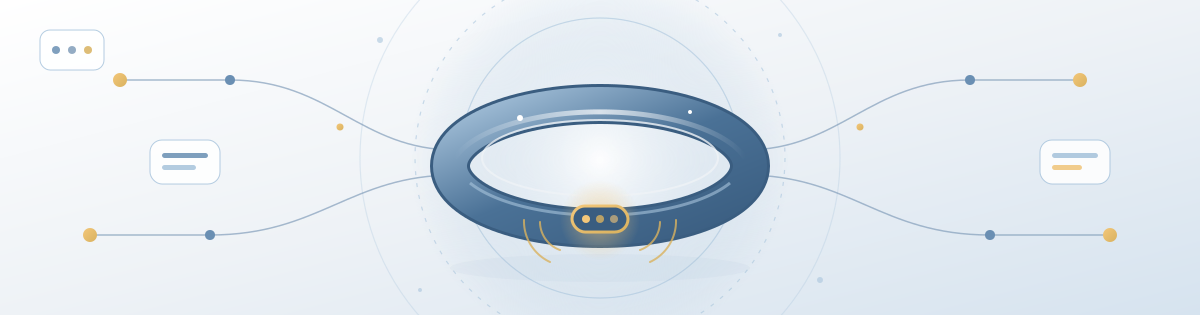
Most AI agents still live behind a screen. Natura, a startup working on both AI and hardware, wants to move them onto your finger. Its new smart ring, called Interface, costs $99. You press it to send a request to an AI agent, record a thought or start a task without picking up your phone.
The ring is also a health tracker. It records heart rate, heart rate variability (HRV), sleep and activity. Natura expects preorders to open next month and shipping to start in December or January.
From earbuds to a ring
Interface is Natura's second device. The first was HumanPods, AI-enabled earbuds for talking to agents. The company later decided that recent progress in voice technology needed a different form factor.
Founder Carlo Edoardo Ferraris previously started Rolling Square, a tech accessories company. After years of making consumer hardware, he concluded that fast-moving AI needs a new interface, one where people ask for things the way they would ask another person.
His case for the ring is constant access. "You really want to have access to your agents 24/7," he told TechCrunch, adding that a ring works "because it's basically an extension of you. You can go shower with it; you can sleep with it. You never take it off."
What the ring is supposed to do
At launch, Interface will connect to several agents and apps, including Meta's Muse, Instinct, Grok Bot, Claude and ChatGPT. Users can choose which agent handles which request. For example, Claude could write code while Instinct books a reservation.
Natura's examples of everyday use include:
- starting workout tracking during a run
- asking for the day's schedule after waking up
- reordering shampoo from the shower
- turning off the TV and setting a morning alarm at bedtime
- recording a meeting and sending the notes to a colleague
Answers come back through connected headphones, an iPhone Live Activity or the NatureOS app. The ring can also control devices, computers included. Ferraris thinks AI agents will eventually do most computer work, such as filling out forms, sending messages, finding files and drafting presentations, all through short voice requests.
Pricing, battery and hardware
Natura says the $99 price is temporary and plans to raise it once usage and demand grow. After a free period of three to six months, users will pay a $9 monthly subscription. The company says its manufacturing costs are similar to those of the Oura Ring and Samsung Galaxy Ring, since the devices share many components. It is pricing lower at first to make it easier for people to try.
Health features cover heart rate, resting heart rate, HRV, sleep stages, steps and daily movement, plus skin temperature over time. Battery life is six to 12 days depending on use, and a full recharge takes 100 minutes.
The smart ring market is already crowded. Oura, Ultrahuman and RingConn focus on health. Pebble and Vocci focus on AI. Ferraris argues that Interface is different because it offers both, with long battery life in a small size.
Our Take
Interface reflects a wider trend: the agent is becoming the product, and the device is just a way to reach it. We have already seen this with assistants that live in text messages. A ring takes the same idea further, cutting the interface down to a button and a voice.
The pitch depends on things Natura does not control. The ring is only as useful as the agents it connects to, and Ferraris admits that early buyers will mostly be tech workers who already use personal agents. His expectation that most people will have one within about a year is a forecast, not a fact.
Three things are worth watching after launch. First, whether routing requests across several agents works smoothly in daily use. Second, whether buyers accept a $9 monthly fee on top of the ring's price. Third, whether a voice-first ring can really handle tasks that currently need a screen. If it can, it will be a strong argument for screenless AI hardware.