Legato, a hearing technology startup, has started selling its first product. Legato Frames are glasses with hearing assistance built into the arms, and they use AI to pick voices out of background noise. The company announced on Thursday that they are now available. Prices start at $999. The glasses are aimed at adults with hearing loss up to a moderate level.
The company says it wants to make hearing care easier to access by addressing three common reasons people avoid hearing aids: cost, comfort, and stigma. Placing the technology in a pair of glasses is its answer to all three.
US companies are running more AI workloads than ever, and they are paying less for them. That is the main finding of the latest Ramp AI Index, compiled by Ramp economist Ara Kharazian.
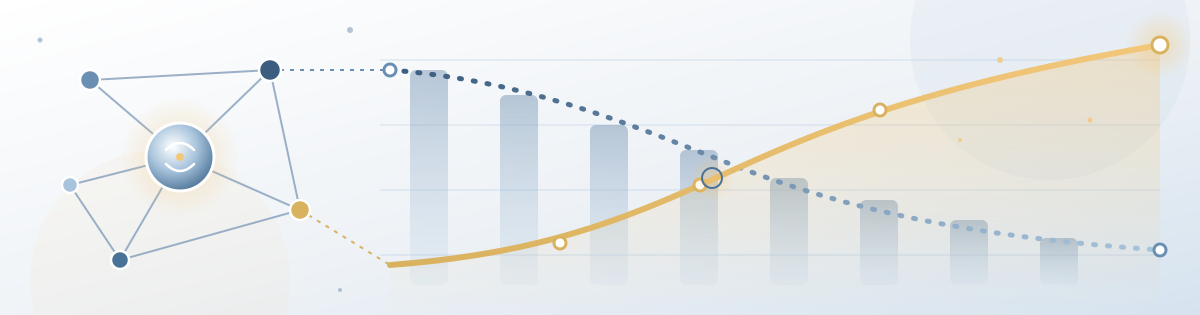
The two lines are moving in opposite directions. Spending peaked in July and has fallen since. Usage has climbed about 50 percent over the same period and reached a record high at the end of September.
Why the bill is shrinking
Kharazian identifies two causes:
Price cuts on top models. The most capable models have become cheaper to call.
Better budget options. Standard and lite models have become cheaper and more efficient, so more work can move to lower-cost tiers.
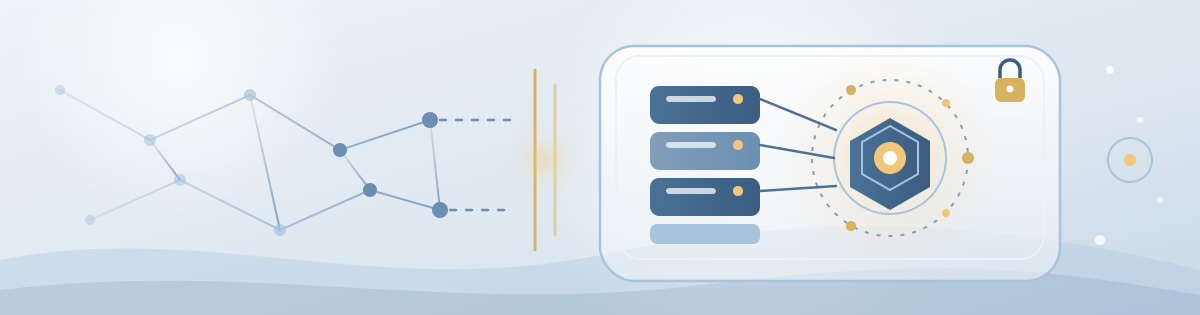
IBM has released a self-hosted version of IBM Bob, its agentic software development platform. Companies can now run AI-assisted development and application modernization on their own infrastructure instead of sending code to an outside service. The option covers on-premises data centers, private clouds, sovereign clouds and fully air-gapped environments. A sovereign cloud keeps data under a specific country's or region's jurisdiction. An air-gapped environment is cut off from external networks entirely.
The target customer is clear. These are organizations whose source code is sensitive, whose data is regulated, or whose systems are too critical to expose to an externally hosted AI tool. IBM is pitching the release to financial services, government, healthcare and critical infrastructure, and to any business worried about protecting its intellectual property.
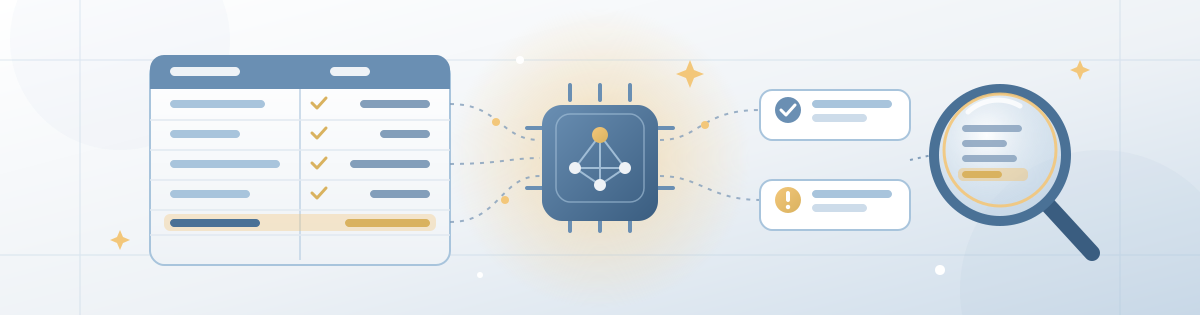
AI models now handle structured bookkeeping work faster, more accurately and far more cheaply than trained accountants. That is the main result of a new study from Mercor. The same study also shows that these systems still cannot finish a full accounting cycle without a human checking the work.
The two findings point in different directions, and both matter. Below is what the study measured, what it left out, and why the gap between the two is the real story.
The head-to-head test
Mercor recruited 12 licensed CPAs. CPA stands for certified public accountant, the main professional accounting credential in the United States. On average, the participants had five and a half years of experience. They worked through simplified tasks taken from the APEX Accounting Benchmark, Mercor's test suite for accounting work.
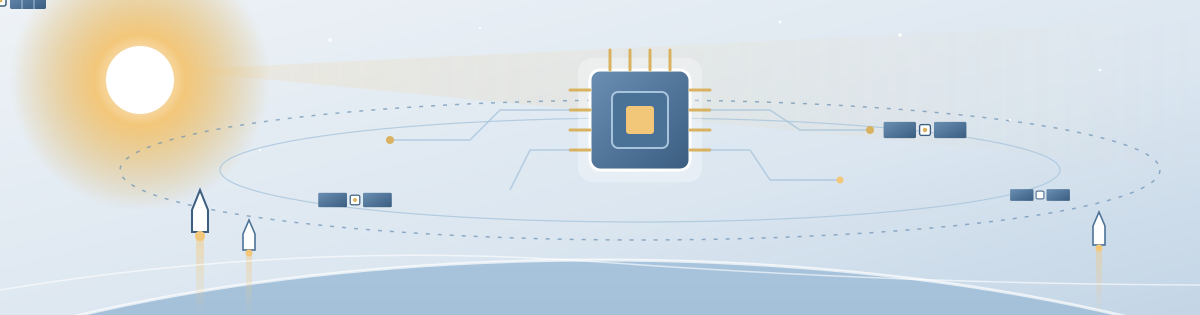
Google has put one of its own AI chips into orbit for the first time. A prototype compute satellite carrying a Google Tensor Processing Unit (TPU) lifted off on a SpaceX rocket from California. It is the first hardware test of Project Suncatcher, the company's plan to build large compute clusters in space.
On the same day, Google published a peer-reviewed version of its white paper on orbital data centers. The paper sets out how much has to change before the idea becomes practical, and much of that depends on SpaceX's Starship flying far more often than it does today.
CyrioX is financed by advertising. You can choose how you want to use this website:
With advertising: we load an advertising script from a third-party ad network. The ad network may set cookies, use your IP address and device information, and may process data outside the EU. We also count your visits for our own visitor statistics (with a random ID stored in your browser).
Ad-free for €0.99 per month: no advertising and no advertising tracking. Cancel at any time.
You can change your decision at any time via "Cookie Settings" at the bottom of every page.