
Google Suncatcher: Space AI Needs 1,800 Starship Launches
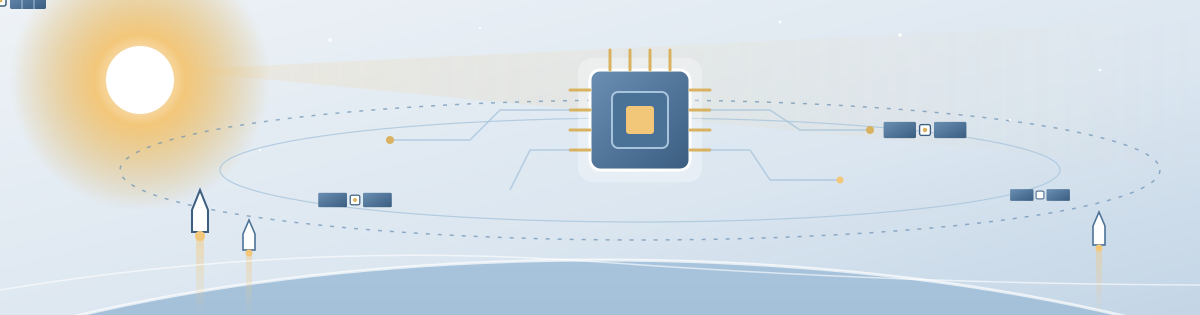
Google has put one of its own AI chips into orbit for the first time. A prototype compute satellite carrying a Google Tensor Processing Unit (TPU) lifted off on a SpaceX rocket from California. It is the first hardware test of Project Suncatcher, the company's plan to build large compute clusters in space.
On the same day, Google published a peer-reviewed version of its white paper on orbital data centers. The paper sets out how much has to change before the idea becomes practical, and much of that depends on SpaceX's Starship flying far more often than it does today.
What the prototype has to prove
The satellite was built by Planet Labs on one of its standard platforms. Its job is narrow: show that a TPU, Google's in-house alternative to Nvidia's GPUs, can actually work in orbit.
That comes down to three things:
- Supplying a kilowatt of continuous power.
- Keeping the chip cool.
- Running a set of models and watching for failures.
Once the satellite is commissioned, the TPU will run in 15-minute bursts. The limit protects the satellite's power and thermal systems, which were not designed around a high-performance processor.
"We've done testing on the ground, but you know, there's no test that's completely as good as the real thing," said Travis Beals, the Google executive who manages Project Suncatcher.
A follow-up demo is planned for next year. It will use two satellites built more specifically for advanced compute, able to handle heavier workloads. The pair will also try to work together over a laser communications link.
Not the only AI payload on board
The same SpaceX launch carried more than 100 payloads, including missions from Satlyt and Cowboy Space Company. Space-based AI is no longer a one-company idea.
Google's effort differs in its time horizon. Beals calls Suncatcher a "long-term moonshot." The target design is a network of 81 satellites flying in close formation and processing in parallel.
"The bandwidth and the latency between TPUs really, really matters when you're trying to run a multi-rack workload...we're trying to look ahead to not just what workloads exist today, but where they will be in five years," Beals said.
The long view is partly a matter of necessity. The rockets needed to scale orbital data centers at a reasonable cost do not exist yet.
The launch math
The white paper, which will appear in the journal Joule, is one of the more rigorous public analyses of how compute could reach orbit. The authors stress that it is not an economic feasibility study. Still, it shows how Google expects launch costs to fall.
Like other data center operators, Google is counting on SpaceX. It is also a major SpaceX investor. The researchers argue that SpaceX has achieved a "learning curve" that has cut prices by about 20% a year since the Falcon 1. On that basis, they consider launch prices near $200 per kilogram by 2035 a reasonable expectation.
Getting there is another matter. Using Falcon 9's payload history as a guide, the paper estimates Starship would need to carry 370,000 tons to orbit to follow a similar cost curve. That works out to roughly 1,800 launches over ten years, or 180 a year, assuming 200 metric tons per flight.
Starship has never flown more than five times in a single year. Elon Musk has suggested it could reach an hourly flight rate in 2029, but his timelines have a mixed record.
Radiation looks manageable
The more encouraging finding concerns radiation. Google had to repeat particle accelerator tests after realizing the original chip configuration gave more shielding than the hardware would get in orbit. The redo showed slightly more errors in the chip's logic circuitry.
Google remains confident the TPUs can handle large inference workloads over a satellite's five-year life.
"The error rate is very low if you're thinking about typical inference operations, right? Like one in a million," Beals said. "On the other hand, it was already problematic for doing, say, some mega-scale training run where you're going to have many thousands of chips running for months."
Why It Matters
The AI industry is running into limits on the ground: power, cooling and land. Companies are already leaning on public support to build terrestrial capacity, as seen in Meta's data center tax credit. Suncatcher is Google's bet that some of that load could eventually move off the planet.
The radiation results suggest a split future. Orbit may suit inference, where rare errors are tolerable. Long training runs look like a poor fit, at least on current evidence. It also matters that Google is testing its own silicon rather than Nvidia's, in line with a broader push to reduce dependence on Nvidia across the industry.
The real bottleneck is not the chip. It is launch cadence, and that sits largely with one company. It is worth watching whether next year's two-satellite demo gets its laser link working, and whether Starship's flight rate starts climbing toward the numbers Google's own paper assumes.