
SAP Joule Becomes an Agentic Work Layer Across Apps
SAP SE is changing how it talks about AI agents. At SAP Connect 2026, the German software company said its Autonomous Enterprise architecture will become generally available this month. SAP first introduced the architecture at Sapphire, its customer conference, in May. It ships alongside two new products, Joule Work and Joule Desktop, and a larger set of autonomous assistants and agents.
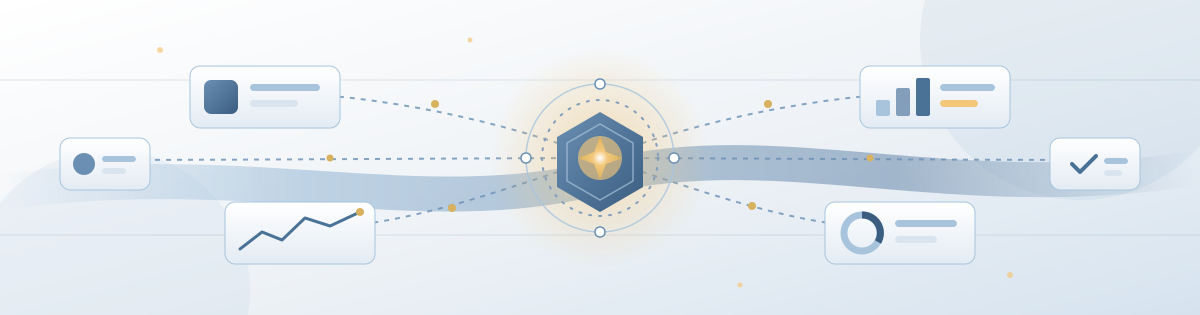
The main change is about where agents run. SAP no longer wants AI to sit inside each application. It wants agents to sit above the applications and work across them.
From chat assistant to work layer
Joule launched in 2023 as SAP's generative AI assistant and has since become the center of the company's automation strategy. With this release, SAP is positioning it as a conversational interface that runs alongside a customer's software rather than inside a single app.
Manoj Swaminathan, SAP's president and chief product officer of Autonomous Suite, put it simply in an interview with SiliconANGLE: "First principle is it's AI on apps as opposed to AI in apps."
He also said the interface has grown beyond a chat window. "Joule is no longer a natural language chat client for us; it is a full-screen experience," he said.
The release has three parts:
-
Joule Work is the framework that brings assistants into customer workflows. It works with both SAP and non-SAP applications.
-
Joule Desktop is the interface layer. It sits where users already work, pulls the same enterprise information and handles the task itself instead of tying it to one application's resources.
-
Updated agents cover finance, supply chain, spend, workforce and customer experience, plus industry-specific areas across the autonomous suite.
How it works in practice
Swaminathan used total corporate spend as an example. Today that question doesn't fit neatly into one application. Joule could work out that the answer needs data from ERP (enterprise resource planning, the core system companies use for finance and operations), from travel and expense tools and from procurement platforms. It would then combine the records and return a single business answer.
Most office workers have already seen simpler versions of this, such as an agent drafting a memo in a word processor or searching old threads in an email client. SAP's claim is that connecting ERP data, finance documents and email in one flow is where it has an advantage.
Autonomy with a human in charge
Swaminathan argued that "autonomous" does not mean handing everything to agents and walking away. In his view, customers first need tools to observe agents, describe what they should do and build trust in them before delegating any process. Control, governance and an audit trail of agent activity come first.
"When we talk about autonomous enterprise, we realize that it's going to be a journey for the customer," he said, adding that it is not something that switches on overnight just because agents are available.
In SAP's model, users state their intent and the agent decides which systems to use. Agents are treated much like employees, with security rules, systems of record and defined execution rights. Humans stay in the loop for governance and transparency.
The data argument
Swaminathan made a pointed claim about the competition. Customers bring their own data and cloud lakehouses, and SAP organizes that data into a structured knowledge graph. General-purpose models and agents from OpenAI and Anthropic, he argued, cannot deliver that context when they are simply placed on top of enterprise data. ERP data, processes, semantics, policies and the relationships between them are what he called SAP's "secret sauce."
SAP is not the only vendor taking this route. Salesforce and ServiceNow are also moving toward headless applications, context layers and agentic control planes.
Pricing and availability
SAP will keep charging through AI units. The model is mainly consumption-based rather than a flat subscription: agent inference uses up units, and customers can see how much they consume. The Joule updates will roll out throughout October, and customers can already browse the agents in SAP's Discovery Center.
Our Take
For enterprise IT teams, the "AI on apps" framing is the part to watch. It suggests the main interface for business software may move away from individual application screens toward an agent layer that queries many systems at once. SAP, Salesforce and ServiceNow all appear to be competing to own that layer, and whoever controls it would gain significant leverage over customers.
SAP's focus on observing agents, auditing them and treating them like employees fits a wider trend. Vendors are increasingly selling governance alongside capability, as seen in efforts such as IBM and CoreWeave's agent workload controls. The jab at OpenAI and Anthropic also lands at a time when large companies are reconsidering how they use general-purpose models, as the recent Claude pullback at Meta and Microsoft shows.
Consumption pricing deserves close attention. Agents that reach across several systems for a single answer could use a lot of inference, and usage visibility alone does not cap a bill. It is worth watching whether SAP adds hard limits like the token spending caps Cohere recently introduced. The other open question is whether the knowledge graph advantage holds up in real deployments, especially in companies with many non-SAP systems.