IBM has released a self-hosted version of IBM Bob, its agentic software development platform. Companies can now run AI-assisted development and application modernization on their own infrastructure instead of sending code to an outside service. The option covers on-premises data centers, private clouds, sovereign clouds and fully air-gapped environments. A sovereign cloud keeps data under a specific country's or region's jurisdiction. An air-gapped environment is cut off from external networks entirely.
The target customer is clear. These are organizations whose source code is sensitive, whose data is regulated, or whose systems are too critical to expose to an externally hosted AI tool. IBM is pitching the release to financial services, government, healthcare and critical infrastructure, and to any business worried about protecting its intellectual property.
AI models now handle structured bookkeeping work faster, more accurately and far more cheaply than trained accountants. That is the main result of a new study from Mercor. The same study also shows that these systems still cannot finish a full accounting cycle without a human checking the work.
The two findings point in different directions, and both matter. Below is what the study measured, what it left out, and why the gap between the two is the real story.
The head-to-head test
Mercor recruited 12 licensed CPAs. CPA stands for certified public accountant, the main professional accounting credential in the United States. On average, the participants had five and a half years of experience. They worked through simplified tasks taken from the APEX Accounting Benchmark, Mercor's test suite for accounting work.
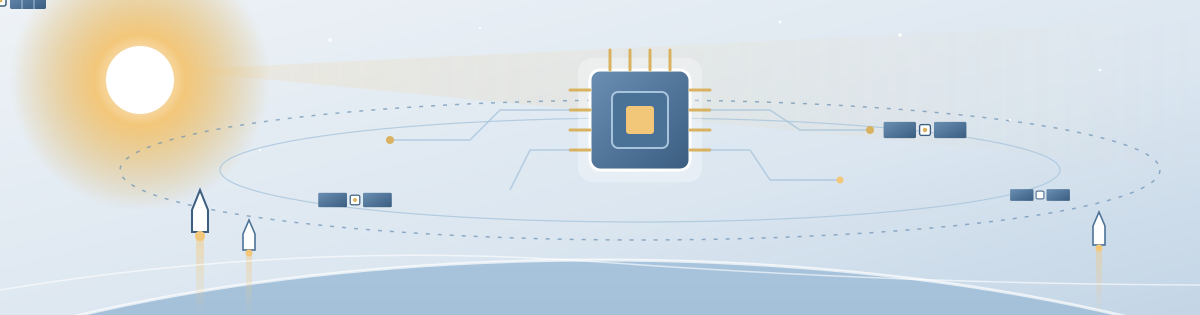
Google has put one of its own AI chips into orbit for the first time. A prototype compute satellite carrying a Google Tensor Processing Unit (TPU) lifted off on a SpaceX rocket from California. It is the first hardware test of Project Suncatcher, the company's plan to build large compute clusters in space.
On the same day, Google published a peer-reviewed version of its white paper on orbital data centers. The paper sets out how much has to change before the idea becomes practical, and much of that depends on SpaceX's Starship flying far more often than it does today.
Black Forest Labs (BFL) has released Flux 3 Image, the image-generation part of its new Flux 3 model family. The main selling point is editing. According to BFL, users can make several edits in a row without the model changing parts of the picture they never asked it to touch.
That is a narrow claim, but an important one. Most people who refine an AI image over several rounds want each change to stay contained, so that fixing a background does not also alter a face or a product label. BFL says Flux 3 Image handles that kind of step-by-step workflow. So far, that comes from the company itself and has not been independently tested.
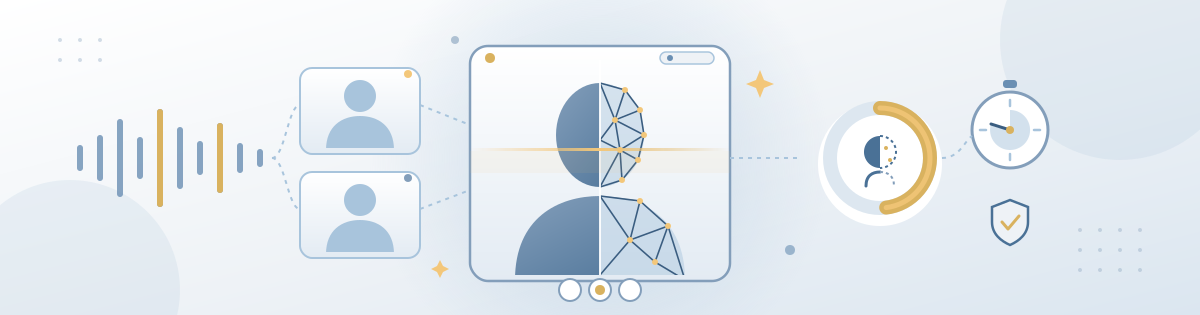
Tavus, a San Francisco startup, wants its AI to hold a face-to-face conversation well enough that you can't tell it is a machine. Its new model, Griffin, is the closest the company has come so far. In Tavus' own study, nearly half of participants finished a one-minute video call convinced they had been talking to a human.
What Griffin is
Tavus calls Griffin the first "Human Interaction Model," or HIM. The label describes a class of model built to understand and carry on face-to-face conversations in real time. It is meant to do more than generate text or a talking head.
CyrioX is financed by advertising. You can choose how you want to use this website:
With advertising: we load an advertising script from a third-party ad network. The ad network may set cookies, use your IP address and device information, and may process data outside the EU. We also count your visits for our own visitor statistics (with a random ID stored in your browser).
Ad-free for €0.99 per month: no advertising and no advertising tracking. Cancel at any time.
You can change your decision at any time via "Cookie Settings" at the bottom of every page.