
McKinsey Knowledge Graph Ties Enterprise Data to AI
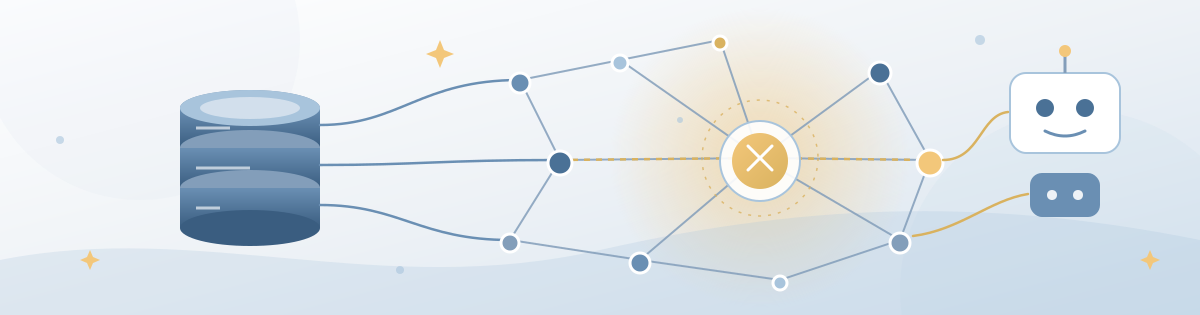
Most companies store their data in large relational databases. These systems handle transactions well, but they are weaker at explaining how a customer, a product and a process relate to each other. McKinsey & Company argues that knowledge graphs can fill that gap and give enterprise AI the business context it often lacks.
James Kaplan, a distinguished partner at McKinsey, made the case in an interview with John Furrier of theCUBE Research. The conversation was part of the theCUBE + NYSE Wired: AI Luminaries series on theCUBE, the livestreaming studio of SiliconANGLE Media. Neo4j, a graph database company, sponsored theCUBE's event coverage. SiliconANGLE says sponsors have no editorial control over its content.
A technology people already use every day
Kaplan said graphs are already familiar to most people, even if they don't recognise them. LinkedIn, Wikipedia and social media platforms all run on graph structures. In his view, consumer tech companies saw the value of the approach before most enterprises did.
He contrasted graphs with the relational databases that most businesses rely on. Those databases are "wonderful if you're processing transactional data," he said, but "much less good at ambiguous or complicated data." A graph is "much more intuitive," according to Kaplan, because it describes things through their links to other things. That can mean a customer, a product, a process or a single step within a process.
Turning messy data into rules
The main shift, Kaplan said, is what AI can now do with unstructured information. Before, turning scattered documents and records into usable structure required business analysts or data scientists. That work was slow and costly, and the results were often imperfect.
Now, according to Kaplan, AI can examine complicated processes and produce deterministic business rules programmatically. It can take "messy, uncorrelated, unstructured data" and convert it into structured data, which is often stored in a graph. "That opens up whole new frontiers," he said.
He also argued that business priorities should decide where those AI gains go. His example was a company aiming its AI improvements at customer experience instead of productivity. The value of the graph, he said, grows with its connections: "The richer the interconnections among nodes, the more intelligence you have in the graph and the more things you can determine."
Inside EcliptOS
McKinsey applies this thinking in EcliptOS, which the firm calls an AI operating system. Its stated goal is to link C-suite strategy with day-to-day execution through agentic workflows, meaning AI agents that carry out multi-step tasks. It is built on a semantic data layer, which organises data together with the relationships between the data, and that layer supports generative AI applications.
Kaplan described the result as "a graph of databases." He said graphs have more flexible data schemas than traditional systems. That flexibility makes it easier to build a virtual graph that spans many separate databases without merging them into one. He called that "incredibly powerful."
Our Take
The interview restates an old data problem in AI terms. Companies hold large amounts of information in separate systems, and AI models can only reason over the context they receive. Kaplan's argument is that relationships between data points carry much of the meaning, and that graphs keep those relationships available to the model.
This fits a wider pattern in enterprise software. Vendors increasingly present agents as a layer that sits across existing applications, as SAP does with Joule as an agentic work layer and as Google Cloud does with its single Gemini Agent assistant. McKinsey's "graph of databases" points to the same goal from the data side: connect what already exists instead of replacing it.
Readers should keep the setting in mind. This was a sponsored interview series, and the event sponsor sells graph technology. The source offers no figures on EcliptOS adoption, cost or results, so the claims remain a consulting firm's view, not measured evidence.
It is worth watching whether AI-generated "deterministic business rules" hold up in practice. Rules extracted automatically from messy data may still need human review before agents act on them. Two other open questions are how companies govern a virtual graph that spans many databases, and whether the customer-experience focus Kaplan described shows up in real deployments.